Generative Computergrafik (Stuttgart, 1965)
JAEV Notes · October 2026 · 2 min read
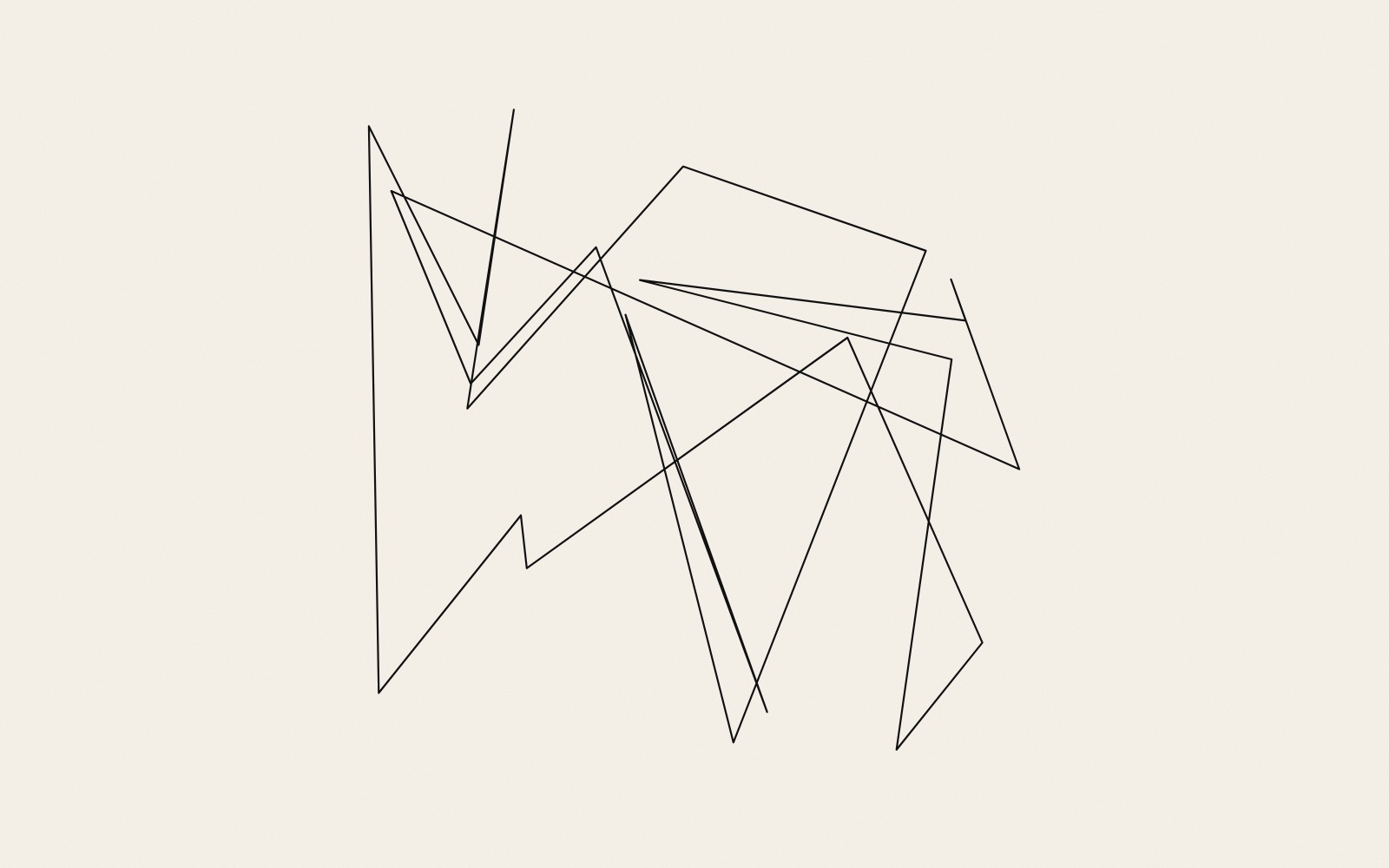
Generative Computergrafik was a small exhibition of drawings by the mathematician Georg Nees, shown in Stuttgart from 5 to 19 February 1965. It is usually counted among the first exhibitions of computer art anywhere, and as the first in Europe.1, 2
Where and what
The exhibition is listed as shown at the Studiengalerie of the Technische Hochschule Stuttgart, now the University of Stuttgart. In practice that meant the seminar room of the Institute of Philosophy, on the eighth floor of the Hahn-Hochhaus. The institute's director, the philosopher Max Bense, regularly showed concrete and constructivist art and poetry there.1, 2
On the walls were about a dozen drawings: thin black lines, matrices of small figures in variation, overlapping rectangles. Nees worked for Siemens in Erlangen. He wrote the programs in ALGOL 60; a computer calculated the drawing and stored it as instructions on paper tape, and the tape drove a Zuse Graphomat Z64, a precise but slow flatbed drawing machine.1
The booklet
Issue 19 of rot, a series of small square booklets edited by Bense and Elisabeth Walther, was on sale at the opening. It held six of Nees's drawings, among them 23-Ecke (Polygon of 23 vertices) and Andreaskreuz (St Andrew's cross), and a three-page text by Bense, "Projekte generativer Ästhetik" (Projects of generative aesthetics). Frieder Nake calls it, in retrospect, the first manifesto of computer art.1, 3
The opening
Nake was at the opening on the afternoon of 5 February and wrote down what he remembered in 2009. Many of the artists present were hostile. One asked whether Nees could make his machine draw like an artist. Nees answered: "Yes, I can. If you can tell me precisely how to define your way of drawing." Professors from the Academy of Fine Art left, some slamming doors. Bense tried to calm them: "what you see here is only artificial art."1 The quotations are Nake's English rendering of a German conversation, from memory.
Afterwards
From 5 to 26 November 1965 Nees and Nake showed together at Galerie Wendelin Niedlich in Stuttgart. The DAM timeline counts it as the third public show of art programmed for a digital computer and drawn by a plotter.1, 2 The exhibitions of that year, in Stuttgart and New York, are described in Generative Art.
Nees went on to make Schotter, explained in the note Schotter, and in 1969 wrote a doctoral dissertation called Generative Computergraphik.4 The longer story is told in Georg Nees; the drawing machine has its own note, Zuse Graphomat Z64. What followed in Zagreb in 1968–69 is in Tendencies 4.
Sources
- Frieder Nake, “The Semiotic Engine: Notes on the History of Algorithmic Images in Europe”. Art Journal, Spring 2009
“It is the afternoon of February 5, 1965.” — Nees at Studiengalerie, Universität Stuttgart, February 5–19, 1965; Nees and Nake at Galerie Wendelin Niedlich, November 5–26, 1965. Captions: works “first published in rot 19 on the occasion of the Generative Computergrafik, Stuttgart, February 1965.” Nake: “This account of the situation and the words spoken are based on my memories as an eye-witness.” - “Timeline: Events”. DAM Digital Art Museum, Berlin
February 5 – February 19, 1965, ‘Generative Computer Graphics’, Studiengalerie der Technischen Hochschule Stuttgart, “with Max Bense inviting artist Georg Nees”; November 5–26, 1965, ‘Computer Graphics’, Galerie Niedlich, “the third public show of artistic works programmed for a digital computer”. - “Georg Nees”. Wikipedia (English)
Nees 23 June 1926 – 3 January 2016; exhibition listed as “computer graphik”; “computer-grafik”, in: rot 19, edition rot, Stuttgart 1965, eds. Max Bense and Elisabeth Walther. - Georg Nees, Generative Computergraphik. Doctoral dissertation, 1969, with the 2006 reprint. Internet Archive
- Published
- JAEV Notes, October 2026.
- Use
- Text CC BY 4.0. Free to use and quote with credit to JAEV and a link to this page. Images and quotations by others keep their own terms.
All texts as one file: archive.json - Cite
- JAEV Notes, “Generative Computergrafik (Stuttgart, 1965)”, jaev.gallery/notes/generative-computergrafik-stuttgart-1965/, 2026.
- Corrections
- Additions and corrections are welcome: info@jaev.gallery
- Share
A link from your own site, course page or reading list helps others find it.- Follow
- New notes by RSS · Instagram · Bluesky
JAEV is a daemon taking shape: machines, weights, room, brain.