Hommage à Paul Klee 13/9/65 Nr. 2 (Frieder Nake, 1965)
JAEV Notes · October 2026 · 2 min read
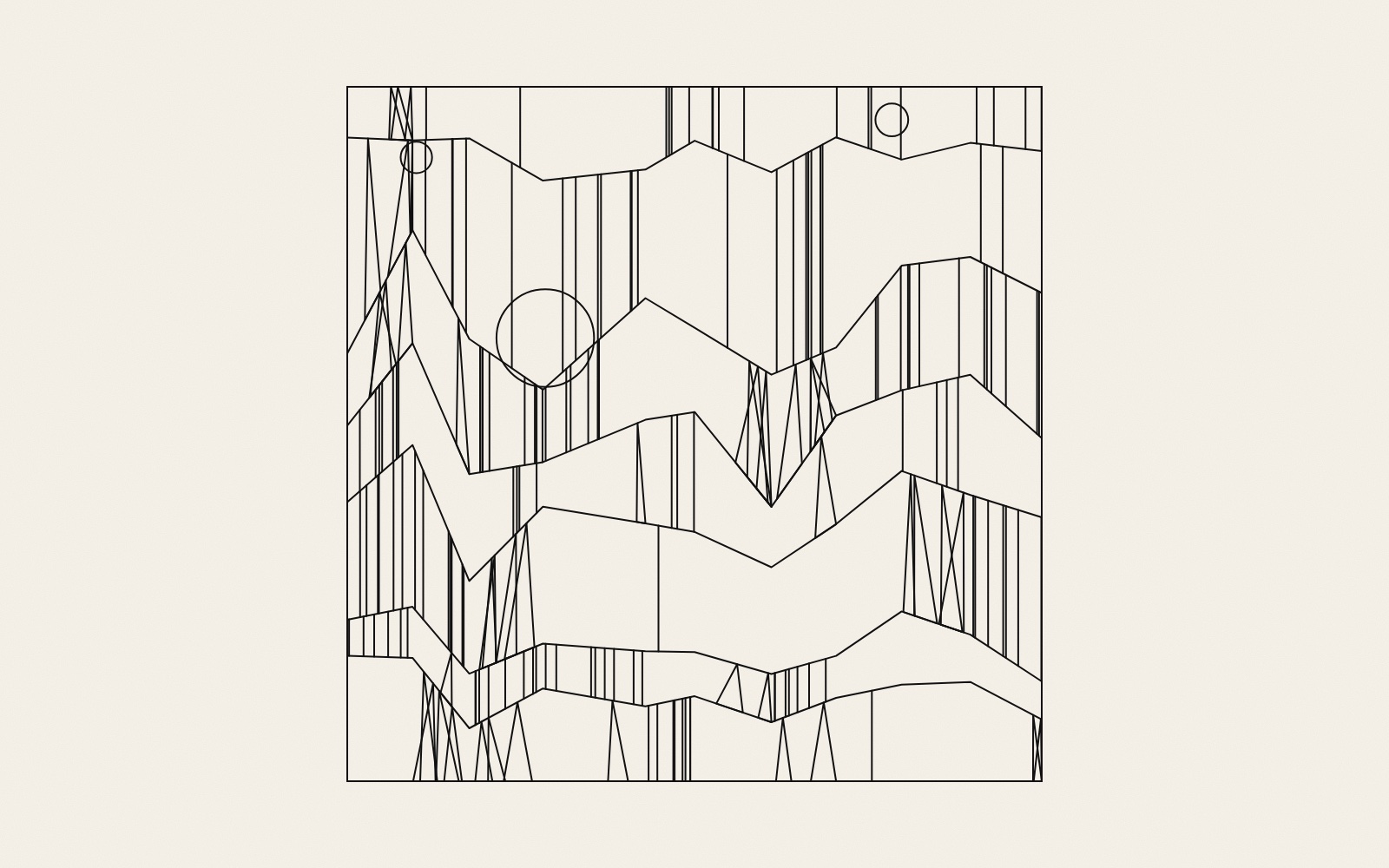
Hommage à Paul Klee 13/9/65 Nr. 2 is a plotter drawing by the mathematician Frieder Nake, dated by its title to 13 September 1965. Nake wrote the program for a Standard Elektrik Lorenz ER56 computer, and a Zuse Graphomat Z64 drew the result with a pen.1, 2 It is, in the words of one gallery text, one of the drawings most often cited in books and articles about the earliest phase of computer art.3
The painting behind it
The starting point was Paul Klee's oil painting Hauptweg und Nebenwege (Highway and Byways) from 1929, now in the Museum Ludwig in Cologne.2
Nake did not try to copy the painting. The Digital Art Museum quotes him: the drawing is "in no respect the attempt of a simulation".4 According to the V&A, he took from Klee the proportions and the balance of vertical and horizontal lines, fixed a framework of horizontals and verticals, and let random variables choose among a set number of options inside it.2
How it works
The picture is a stack of roughly horizontal bands. The lines between the bands are not straight: they bend at a series of points, the vertices, from the left edge to the right. Between two neighbouring vertices, each band forms a four-sided cell, a quadrilateral. The text on the work published by the Gazelli Art House lists the decisions the program left to chance:3
- the width of each band where it starts, at the left edge;
- how each band edge bends from vertex to vertex, with the rule that no edge may cross another;
- for each quadrilateral, whether it stays empty or is filled with vertical lines or with triangles;
- how many lines or triangles go into it, and where;
- how many circles there are, and the position and radius of each.
The rule against crossing keeps the order of the bands. Everything else may vary. "A lot of pseudo-random decisions were needed to algorithmically realize this structure", the same text says.3
No screen showed the result in advance. Nake saw the picture only when the plotter had drawn it.2
Live sketch
Copies and prints
The program could run again, and each run made a new drawing. Nake estimates that the machine drew "about 30 or 40 copies" between 1965 and 1967, each counted as an original work. In 1966 he made a screenprint edition of 40.4 The V&A holds one of the screenprints; the ZKM in Karlsruhe holds the work as well.2, 1 The machines and dates are compared with other early plotter works in Plotter Art.
Sources
- Frieder Nake, Hommage à Paul Klee 13/9/65 Nr. 2, 1965. ZKM | Center for Art and Media Karlsruhe
Computer: Standard Elektrik Lorenz ER56; software COMPART ER56; output device: Zuse Graphomat Z64; screen print after plotter drawing, 50.1 × 50.1 cm. - Frieder Nake, Hommage à Paul Klee, 13/9/65 Nr.2, 1965. Screenprint. Victoria and Albert Museum, London, E.951-2008
Based on Klee's 1929 painting High Roads and Byroads (Museum Ludwig, Cologne); a horizontal and vertical framework, with random variables choosing among a set number of options; no screen to preview the image. Edition of 40, 49.2 × 49.2 cm. - Frieder Nake, Hommage à Paul Klee 13/9/65 Nr. 2, 1965. Gazelli Art House
“A lot of pseudo-random decisions were needed to algorithmically realize this structure.” The list: band widths at the left edge, bending without crossing, each quadrilateral empty or with vertical lines or triangles, number and position of those signs, number, position and radius of the circles. Signed Nake/ER56/Z64. - “Hommage à Paul Klee”. DAM Digital Art Museum, Berlin
Nake “generated about 30 or 40 copies during the years from 1965 to 1967”; silkscreen edition of 40 in 1966; the drawing is “in no respect the attempt of a simulation”.
- Published
- JAEV Notes, October 2026.
- Use
- Text CC BY 4.0. Free to use and quote with credit to JAEV and a link to this page. Images and quotations by others keep their own terms.
All texts as one file: archive.json - Cite
- JAEV Notes, “Hommage à Paul Klee 13/9/65 Nr. 2 (Frieder Nake, 1965)”, jaev.gallery/notes/frieder-nake-hommage-a-paul-klee/, 2026.
- Corrections
- Additions and corrections are welcome: info@jaev.gallery
- Share
A link from your own site, course page or reading list helps others find it.- Follow
- New notes by RSS · Instagram · Bluesky
JAEV is a daemon taking shape: machines, weights, room, brain.