Moiré patterns
JAEV Notes · October 2026 · 2 min read
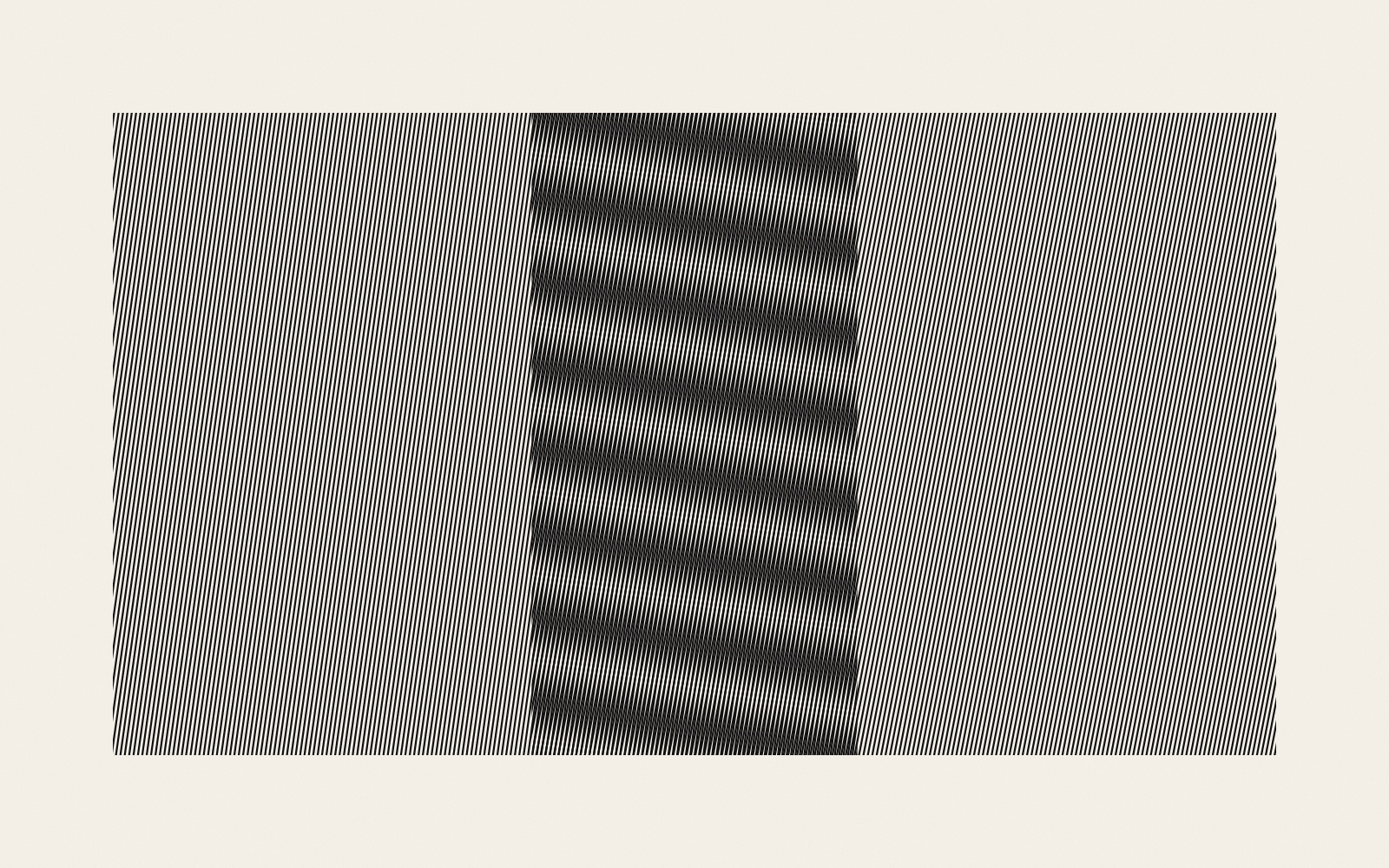
A moiré is a pattern of broad light and dark bands that appears when two fine, regular sets of lines lie on top of each other. Neither set contains the bands. They come from the way the two sets cross: where the lines fall on top of each other, more paper shows and the area looks light; where they fall between each other, they cover more paper and the area looks dark. The word comes from French moiré, a fabric, historically silk, with a rippled "watered" look.1
How wide the bands are
The bands are much wider than the lines that make them, and their width follows from two numbers. Take two identical sets of parallel lines with spacing p and turn one by a small angle α. The light bands are then
D = (p/2) / sin(α/2)
apart, which for small angles is close to p/α (with α in radians).1 Lines 5 px apart, turned by 3 degrees, give bands about 95 px apart, as in the drawing at the top of this page. The smaller the angle, the wider the bands.
That magnification is why moiré is used to measure. A grid printed on a material and compared with an undeformed grid shows strain in the material as bands. It is also why it is a nuisance: in printing, the dot screens of the different inks are set at chosen angles to avoid it; and patterned clothes can make it appear on television.1
On the plotter
A pen plotter makes moiré easily, because it draws many fine lines close together. When the textile designer Astrid Sampe asked IBM to help her draw a red cross by computer, the programmer Sten Kallin noticed that the pen of the IBM 1130's plotter sat a little loose in its holder, so its slanted lines were never quite straight. Laid next to each other, he said, such lines were strengthened by "the moiré effect that arises when you have several lines next to each other, especially if they do not have quite the same angle". He wrote a program that drew the cross many times, each time smaller and turned.2
Kallin went on to make computer pictures with the artist Sture Johannesson, among them the project INTRA.2, 3 Looking back in 2007 he said that what interested him was how lines "that are regular but not too regular" work together to make moiré-like patterns: "It has always amused me a lot."2 The story is told in full in the editorial Computer Art in Sweden. For drawing tone with many lines on a plotter, see line hatching and Plotter Art.
Sources
- “Moiré pattern”. Wikipedia
French moiré, a textile with a rippled, “watered” look, historically silk; for two patterns of step p turned by α, spacing between pale lines D = (p/2) / sin(α/2), for small angles D ≈ p/α; steps p and p + δp: 2d = p²/δp + p; strain measurement, banknotes, halftone screen angles, descreen filters, cameras and television. - Sten Kallin, interviewed by Anna Orrghen, 10 September 2007. Från matematikmaskin till IT, Tekniska museet, Stockholm
The Red Cross for Astrid Sampe on the IBM 1130: the loose pen, the moiré effect when several lines lie side by side, “especially if they do not have quite the same angle”; lines “regular but not too regular” forming moiré-like patterns, “It has always amused me a lot.” - Sture Johannesson and Ann-Charlotte Johannesson, interviewed by Anna Orrghen, 2 October 2007. Från matematikmaskin till IT, Tekniska museet, Stockholm
Abstract: “During the seventies and the eighties Sture worked together with Sten Kallin from IBM as they used computer technology to develop the projects INTRA and EPICS.”
- Published
- JAEV Notes, October 2026.
- Use
- Text CC BY 4.0. Free to use and quote with credit to JAEV and a link to this page. Images and quotations by others keep their own terms.
All texts as one file: archive.json - Cite
- JAEV Notes, “Moiré patterns”, jaev.gallery/notes/moire-patterns/, 2026.
- Corrections
- Additions and corrections are welcome: info@jaev.gallery
- Share
A link from your own site, course page or reading list helps others find it.- Follow
- New notes by RSS · Instagram · Bluesky
JAEV is a daemon taking shape: machines, weights, room, brain.