Sture Johannesson (1935–2018)
JAEV Notes · October 2026 · 3 min read
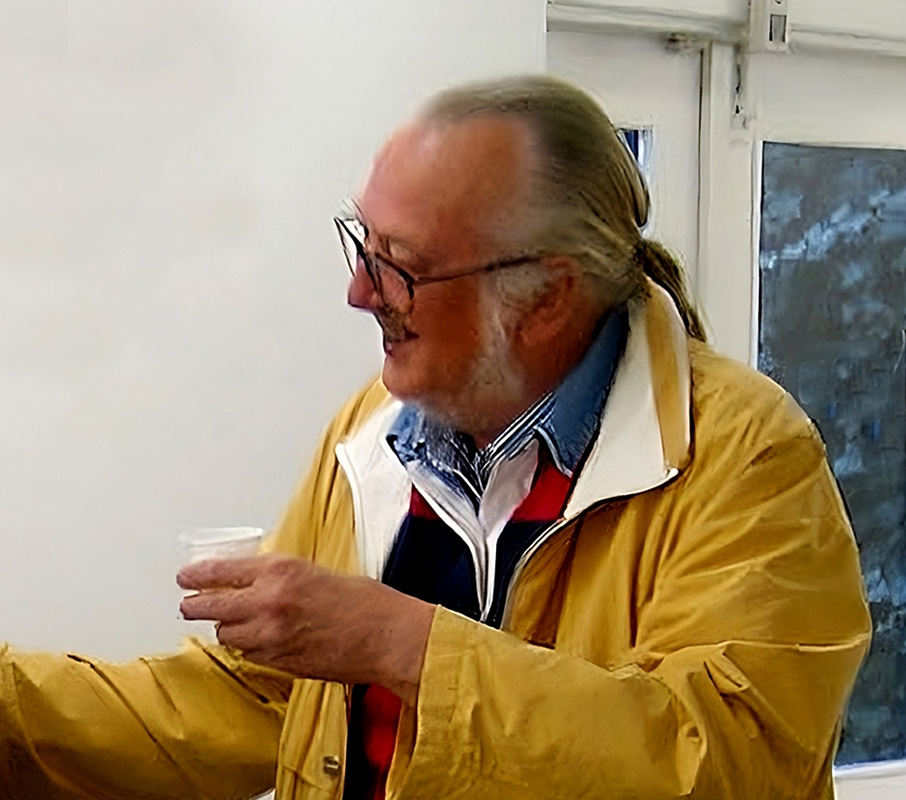
Sture Johannesson (1935–2018) was a Swedish poster artist who became one of the first artists in Sweden to make pictures with a computer. He was born in Vinslöv in Skåne and died in Skanör.1 His computer pictures were made at IBM with the engineer Sten Kallin.
The poster, 1968
In the 1960s Johannesson made political posters, and with his wife, the textile artist Charlotte Johannesson, he ran Galleri Cannabis in Malmö.1 In 1968 Lunds konsthall asked him for a poster for Underground, an exhibition planned for 1969. The poster, Friheten på barrikaderna II, a parody of Delacroix's Liberty Leading the People, was attacked as drug propaganda. The exhibition never opened and the director, Folke Edwards, resigned.1, 2, 3 The konsthall stayed closed for "several months" according to its own account, for a year and a half according to Johannesson.2, 3
Afterwards, he said, no Swedish venue would show him. He turned to IBM instead, by letter in his own account, by telephone in Kallin's. It reached Kallin, who taught programming there. Johannesson was given a key to IBM's laboratory in Solna, where he could let himself in and lock up when he left: "there I had an artistic freedom that does not exist in the art world."3, 4
INTRA: one line
Their first project, INTRA, ran from 1969 to 1974 on an IBM 1130 with a pen plotter.5 Johannesson came with an "alphabet" of three signs he had already painted, printed and fired in ceramic: a keyhole, a heart, and the shape, like a crown, that the two make when laid on top of each other. Kallin wrote programs that drew forms as curves from mathematical formulas. The rule was that each picture was a single line: "It is all just one line, and that is the point." They used the pen's slight wobble on purpose, and lines laid close together produced moiré.4
Johannesson did not program. Kallin finished each program and gave him as many parameters as he could, so that Johannesson sat at the machine and chose the values. Kallin thought the main creative part lay with whoever designs the program, "because it sets the frame entirely".4 Programs of the same kind drew a three-dimensional section sign (§), Johannesson's comment on Swedish bureaucracy, and a gramophone record as one line, for a record sleeve by the Skåne musician Peps Persson.4 Two works titled Datorserigrafi IBM (1973 and 1974) are among the 35 works by Johannesson in Moderna Museet's online collection.6
Digitalteatern and EPICS
In the early 1980s the Johannessons ran their own Apple-based studio, Digitalteatern, in Malmö.3 In the mid-1980s Johannesson and Kallin began a second project, EPICS (Exploring Picture Space), on a PC AT that IBM lent him. Each element in a picture was given a field of force around it, like gravity, that fell off with distance, and the program made the fields visible. The plan was to analyse paintings such as Cézanne's bathers this way; it got no further than mathematical objects.3, 4, 5
Of his work with Kallin, Johannesson said it was not really computer art but "a way of using the computer to show and learn more about things one could use in any kind of picture-making".3 He was critical of the colour cubes from Lund University's computing centre that became works by Beck & Jung, told in The colour cubes. The same cube is a starting point for Olof Broström's Automatic Colour Cubes at JAEV.
Sources
- “Sture Johannesson”. Wikipedia (Swedish)
Born 24 May 1935 in Vinslöv parish, died 17 January 2018 in Skanör; poster artist, assistant to Georg Oddner in the early 1960s; “Friheten på barrikaderna II” (1968) for Underground, Lunds konsthall, 1969; Folke Edwards resigned; hemp plants seized by police in 2004. - Sture Johannesson. Counterclockwise Circumambulation. Lunds konsthall, 29 May – 22 August 2004, curator Åsa Nacking
The poster was banned, Underground never opened, the director had to leave and the konsthall closed for several months. - Sture Johannesson and Ann-Charlotte Johannesson, interviewed by Anna Orrghen, 2 October 2007. Från matematikmaskin till IT, Tekniska museet, Stockholm
In Swedish; quotations translated by JAEV. Original wording: “Jag fick låna nyckel till IBM:s laboratorier i Solna och komma dit själv och låsa upp och låsa när jag gick.” — “där fick jag ju en konstnärlig frihet som inte existerar i konstvärlden.” — “Det var ju inte att det var datorkonst egentligen, utan det var ju ett sätt att använda datorn för att åskådliggöra och lära sig mer om sådana saker man kunde använda i vilket bildskapande som helst …” — on the konsthall: “stängd i ett och ett halvt år”. - Sten Kallin, interviewed by Anna Orrghen, 10 September 2007. Från matematikmaskin till IT, Tekniska museet, Stockholm
Original wording: “Det är bara ett streck alltihop och det är liksom poängen.” — “Nej, han programmerade inte. Inte då i varje fall.” — “jag tror nog att huvudkreativiteten ligger hos den som designar programmet”. - Anna Orrghen, Från matematikmaskin till IT. Fokusgrupp: Media. Slutrapport. Tekniska museet, Stockholm, 2008
INTRA (1969–1974) on an IBM 1130 and a pen plotter; EPICS (1986–); Kallin at IBM 1963–1991. - Sture Johannesson, works in the collection. Moderna Museet, Stockholm
35 works online, among them “Datorserigrafi IBM” (1973 and 1974) and “Chip Challenge” (1981).
- Published
- JAEV Notes, October 2026.
- Use
- Text CC BY 4.0. Free to use and quote with credit to JAEV and a link to this page. Images and quotations by others keep their own terms.
All texts as one file: archive.json - Cite
- JAEV Notes, “Sture Johannesson (1935–2018)”, jaev.gallery/notes/sture-johannesson/, 2026.
- Corrections
- Additions and corrections are welcome: info@jaev.gallery
- Share
A link from your own site, course page or reading list helps others find it.- Follow
- New notes by RSS · Instagram · Bluesky
JAEV is a daemon taking shape: machines, weights, room, brain.