Rörelse i konsten (Moderna Museet, 1961)
JAEV Notes · October 2026 · 2 min read
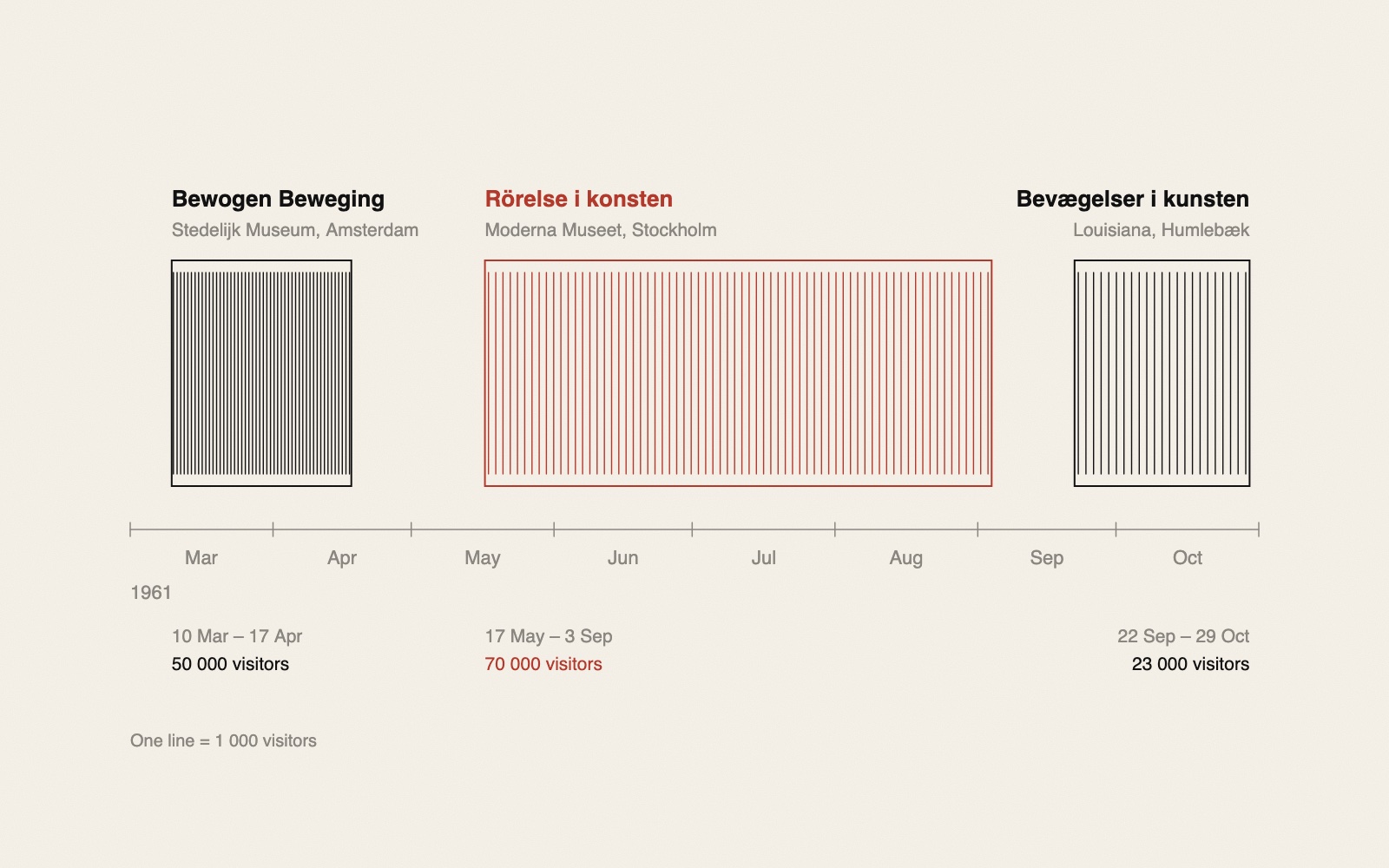
Rörelse i konsten (Movement in Art) was an exhibition of art that moves, shown at Moderna Museet in Stockholm from 17 May to 3 September 1961. It was the first large exhibition of the museum's director Pontus Hultén, produced with the artist Daniel Spoerri, and it was also shown in Amsterdam and in Denmark.1
What was shown
The exhibition had 233 works. The historian Anna Lundström counts 85 artists; Moderna Museet's own anniversary page says 83, and only eight of the works were by women.1, 2 The idea was that movement was the key to all art of the 20th century, from the Futurists' paintings of motion to machines that actually move.1
Just inside the entrance stood Nicolas Schöffer's Cysp I (1956), a 260 cm sculpture that moved across the floor when a button was pressed. The first hall held 32 mobiles by Alexander Calder. The second, darker hall held 27 machines by Jean Tinguely and large wooden constructions by the Swedish artist Per Olof Ultvedt. Visitors could set the mobiles turning and were expected to start Tinguely's machines.1
A machine that draws
Among Tinguely's works was Méta-Matic No. 17 (1959). In Moderna Museet's description it "dances, makes noises and incessantly spits out ink drawings", while the exhaust from its petrol engine slowly fills a balloon until it bursts.3 It draws with no hand on the pen; plotter art later gave the same job to a computer. The machines are described in Tinguely's Méta-Matics.
Objects that were not art
Hultén also wanted what he called the "periphery" of moving art: old automata, mechanical toys, fireworks, racing cars. In the end only a car was shown, a Bugatti behind a rope. He wrote to W. Grey Walter at the Neurological Institute in Bristol to ask about borrowing the institute's "robot turtles", so that they could be shown as works of art.1 Lundström does not say whether they came. The catalogue reprinted "Garden Party", a text by the engineer Billy Klüver, who grew up in Sweden and worked at Bell Labs.1, 4
Three venues
Hultén wanted the exhibition to open in Stockholm, but it opened at the Stedelijk Museum in Amsterdam as Bewogen Beweging, against his protests. Spoerri had argued that in an established museum no one would question whether the objects were art. A letter from Louisiana's director gives the visitor numbers: 50,000 in Amsterdam (10 March–17 April), 70,000 in Stockholm and 23,000 at Louisiana in Humlebæk (22 September–29 October), where the title was Bevægelser i kunsten.1
In the 1960s, under its chairman Knut Wiggen, the Stockholm music society Fylkingen also moved its concerts to Moderna Museet.5 The Stockholm composers and engineers who worked with computers in those years are described in Computer Art in Sweden and in the note on EMS, the electronic music studio.
Sources
- Anna Lundström, “Rörelse i konsten. En utställnings lager”, in Pontus Hultén och Moderna Museet. De formativa åren, Moderna Museet, Stockholm, 2017 (English edition: “Movement in Art. The layers of an exhibition”, Koenig Books, London)
“233 verk av totalt 85 konstnärer”; Cysp I, 260 cm; twelve Rotoreliefs and six records; 32 Calder mobiles, 27 Tinguely sculptures; Méta-Matic nr 17 (1959) and Cyclograveur (1960); Hultén's letter to Gray Walter about the “robot turtles”; a Bugatti; footnote 22: Amsterdam 10 March–17 April (50 000), Stockholm 17 May–3 September (70 000), Humlebæk 22 September–29 October (23 000), from Knud W. Jensen's letter of 4 November 1961; footnote 13: Billy Klüver's “Garden Party” reprinted in the catalogue. - “50 years since Rörelse i konsten (Movement in art)”. Moderna Museet, 14 June 2011
233 works by 83 artists, only eight by women; Calder's The Four Elements, the museum's copy of Duchamp's Large Glass and Man Ray's mobile entered the collection. - Jean Tinguely, Méta-Matic nr 17, 1959 (NMSK 1895). Moderna Museet, Stockholm
“It dances, makes noises and incessantly spits out ink drawings.” “The exhaust from the petrol engine is collected in a balloon that fills slowly until it bursts.” Painted iron and wood, paper, ink, fuel engine, latex balloon; 330 × 170 × 190 cm; donation 1965 from the Friends of Moderna Museet. - “Billy Klüver”. Wikipedia
Grew up in Sweden, KTH graduate; Member of Technical Staff at Bell Telephone Laboratories 1958–1968; founded Experiments in Art and Technology. - Jøran Rudi, “Unpacking the Musical and Technical Innovation of Knut Wiggen”. Organised Sound 23 (2), 2018, pp. 195–207
On Fylkingen under Knut Wiggen, chairman 1959–1969: “Concerts were moved to Moderna Museet”.
- Published
- JAEV Notes, October 2026.
- Use
- Text CC BY 4.0. Free to use and quote with credit to JAEV and a link to this page. Images and quotations by others keep their own terms.
All texts as one file: archive.json - Cite
- JAEV Notes, “Rörelse i konsten (Moderna Museet, 1961)”, jaev.gallery/notes/rorelse-i-konsten-1961/, 2026.
- Corrections
- Additions and corrections are welcome: info@jaev.gallery
- Share
A link from your own site, course page or reading list helps others find it.- Follow
- New notes by RSS · Instagram · Bluesky
JAEV is a daemon taking shape: machines, weights, room, brain.