Herbert W. Franke (1927–2022)
JAEV Notes · October 2026 · 4 min read
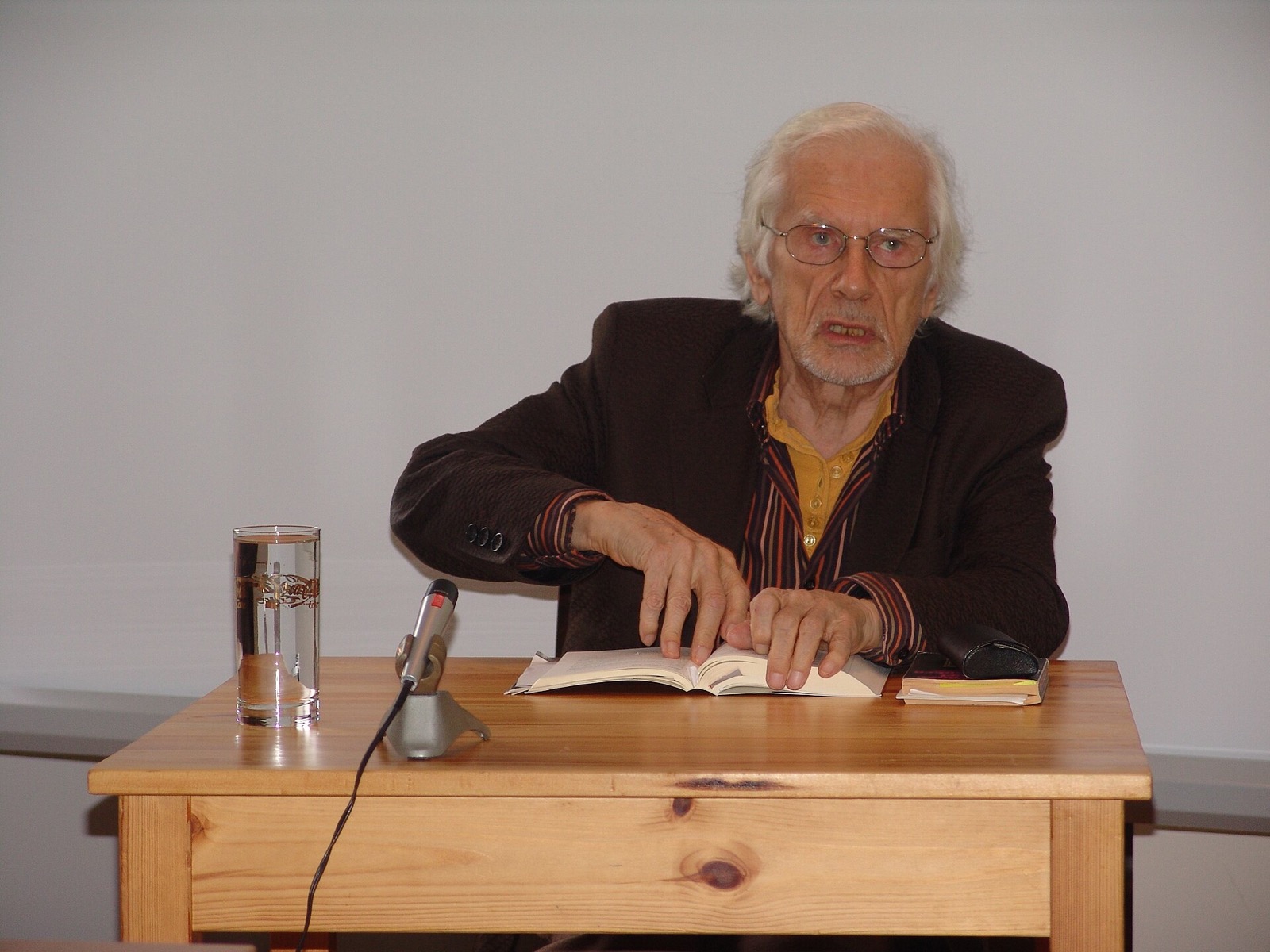
Herbert W. Franke (1927–2022) was an Austrian physicist and science-fiction writer who made pictures with electronic machines from the mid-1950s, first analogue and from 1969 digital. He also co-founded the festival Ars Electronica in Linz in 1979.1, 2
Life
Franke was born in Vienna on 14 May 1927. He studied physics and several other subjects there and took his doctorate in 1950. From 1952 to 1957 he worked in the advertising and press department of Siemens in Erlangen; from 1957 he lived as a freelance writer.1, 2 He wrote the book Kunst und Konstruktion (Art and Construction, 1957),3 novels, popular science and books on art and technology. He died in Egling, Bavaria, on 16 July 2022, aged 95.2
The oscillograms
An oscillograph, or oscilloscope, draws an electrical signal as a moving point of light on a screen. If two oscillating voltages steer the point sideways and up and down at the same time, it traces closed curves, the Lissajous figures also known from pendulum machines.
Franke's first series of such pictures, the Oscillograms, dates from December 1954.3 The Viennese physicist Franz Raimann built an analogue computing system for him, in close collaboration with Franke.4 It added, subtracted, multiplied or divided oscillations before they reached the oscillograph, which was the output device and gave the series its name.3 Franke photographed the screen, and often moved the camera past it while the shutter was open, so that a curve was repeated as "evenly fanned out lines".4
On 3 January 1959 an exhibition of these pictures, Experimentelle Ästhetik (Experimental Aesthetics), opened at the Museum of Applied Arts in Vienna.4 That is six years before the first exhibitions of digital computer drawings, such as Georg Nees's in Stuttgart in February 1965.
Digital work
Franke's first digital computer graphics were the series Quadrate (Squares). A student wrote the program in Fortran in 1968, following Franke's flow diagram, on an IBM 1130 that the Technical University of Munich had built up for the Max Planck Institute of Psychiatry. Squares were placed in three planes, their number, size and position chosen by the computer's pseudo-random generator.5 The engineer Georg Färber had set up the installation, with an interface for an incremental plotter, for experiments at the institute, and he and Wolfgang Probst described it in IBM Nachrichten in 1968.6 As a freelance writer Franke always had to look for computers to work with, which is why he used so many different systems.3 The series KAES followed in 1969, on a Siemens 4004 computer, with a program that Franke conceived and the programmer Peter Henne wrote. The curves were drawn by a plotter and printed as silkscreens, part of a silkscreen series for the 1970 Venice Biennale.7, 3 In 1971 he published Computergraphik – Computerkunst (Computer Graphics – Computer Art), which the V&A describes as one of the first accounts of the field.7, 2
In the 1970s he often worked on machines in the Siemens research centres in Erlangen and Munich.3 The Farbraster (Colour Grids) were made with the Sicograph, a device Siemens in Erlangen developed in 1973 for colouring X-ray images. Franke fed it a random pattern instead of an X-ray, transformed it on screen, and had it printed by an early ink-jet plotter that had only red, green and blue, no black.8 The Rotationen and Projektionen were calculated in real time on an interactive graphics screen at the Siemens research laboratory in Munich, filmed on 16 mm, and in 1974 projected as the set for a dance performance at the Experimentierbühne of the Bavarian State Opera.9
From the 1970s Franke also built his own drawing machines, among them several plotters made from Fischertechnik, the construction kit, with an electric control for drawing curves from cams.10
Ars Electronica
The Ars Electronica festival opened in Linz on 18 September 1979. Its founders were Franke, the electronic musician Hubert Bognermayr, the music producer Ulli A. Rützel and Hannes Leopoldseder of the Austrian broadcaster ORF.11
Where to see the work
Franke gave his archive to the ZKM in Karlsruhe in 2017.1 The foundation that looks after his work has given around 250 analogue and digital works to the Museum Folkwang in Essen, which shows him together with the photographer Gottfried Jäger in Art and Construction, from 16 October 2026 to 10 January 2027.12, 13 The foundation is also publishing his books in an Edition Herbert W. Franke, beginning with Kunst und Konstruktion.14 The early years of computer art in Europe are described in JAEV's Generative Art.
Corrected on 22 October 2026 with information from art meets science – Foundation Herbert W. Franke: the date of the first oscillograms (December 1954), the role of the analogue computer, and Quadrate as Franke's first digital work. The foundation also pointed us to the article by Färber and Probst, the Siemens systems and the Fischertechnik plotters.
Sources
- “Herbert W. Franke”. ZKM | Center for Art and Media Karlsruhe
Born 1927 in Vienna; studied physics, mathematics, chemistry, psychology and philosophy, doctorate 1950; Siemens, Erlangen, 1952–1957; freelance author from 1957; images with photography and electronic devices from the mid-1950s, digital computer graphics from 1969; co-founded Ars Electronica 1979; archive donated to ZKM in 2017. - “Herbert W. Franke”. Wikipedia (English)
Born in Vienna on 14 May 1927; died in Egling on 16 July 2022, aged 95; Computergraphik – Computerkunst (1971); Der Orchideenkäfig (1961); speleology, Dr. Benno-Wolf-Preis 2002. - art meets science – Foundation Herbert W. Franke, comments on this note, email to JAEV, 22 October 2026
Oscillograms December 1954; the analogue computer added, subtracted, multiplied or divided oscillations before display; Kunst und Konstruktion (1957); KAES part of the 1970 Biennale silkscreen series; Quadrate (1968) the first digital work. Second email the same day: the IBM 1130 used for art only once, made possible by Georg Färber; Franke had no relation to the institute and always had to search for computers as a freelance writer; in the 1970s often Siemens machines in Erlangen and Munich; a plotter built with Fischertechnik. - “Art historical classification”. art meets science – Foundation Herbert W. Franke
“The computing system was developed and built by the Viennese physicist Franz Raimann in close collaboration with Franke.” Series “Oscillograms”, created in December 1955, named after the output device; “Franke often moved the camera past the screen when taking pictures, which resulted in evenly fanned out lines”; Experimental Aesthetics opened at the Museum of Applied Arts in Vienna on 3 January 1959. - “Quadrate (Squares – 1968/69)”. art meets science – Foundation Herbert W. Franke
Program first created in 1968 on an IBM 1130 in Fortran; system built 1967 by TU Munich for the Max Planck Institute of Psychiatry; a student wrote the code following Franke's flow diagram; squares in three planes placed by a pseudo-random generator. - G. Färber and W. Probst, “Automatische Versuchssteuerung und Versuchsauswertung mit dem IBM System 1130. Dargestellt an einem Beispiel aus der Medizin”. IBM Nachrichten 18 (1968), no. 188, pp. 126–131 (April); offprint sent to JAEV by the foundation
Färber at the Institut für Nachrichtentechnik of the TH München, Probst at the Department of Experimental Neurophysiology, Max Planck Institute of Psychiatry, Munich: the IBM 1130 installation for running and evaluating experiments, with its plotter interface. The link is the foundation's page on Quadrate; the article itself is not online. - Herbert W. Franke, KAES 1 (Algebraic Curves), 1969–70. Victoria and Albert Museum, London, E.197-2008 (object record text)
Created in 1969 with a program conceived by Franke and written by Peter Henne; KAES from “Kurven, AESthetische”; hardware Siemens 4004; silkscreen after a plotter drawing; 1971 book “one of the first accounts of computer art”. - “Farbraster (Color Grids)”. art meets science – Foundation Herbert W. Franke
Made with the Sicograph, developed in 1973 by Siemens in Erlangen for medical use; a random pattern read in by punch card instead of an X-ray; output on a precursor of the ink-jet plotter, red, green and blue only, no black; most in the Herbert W. Franke Collection, Kunsthalle Bremen. - “Rotationen / Projektionen”. art meets science – Foundation Herbert W. Franke
Real-time graphics on an interactive screen at the Siemens Research Laboratory, Munich; programs by Gerhard Geitz, Monika Gonauser, Egon Hoerbst and Peter Schinner; filmed on 16 mm; stage set for a dance performance with Gerald Bohner at the Experimentierbühne of the Bavarian State Opera, 1974. - “Rotation Plate, Fischertechnik and Spirograph (1958–1974)”. art meets science – Foundation Herbert W. Franke
Homemade drawing machines since the 1970s; several plotter models for CAM curves with an electric control; friendship with Arthur Fischer; consultant for Fischertechnik; a Fischertechnik plotter for sale failed on the marketing department. - “Ars Electronica 1979”. Ars Electronica
Founders: Herbert W. Franke, Hubert Bognermayr, Ulli A. Rützel and Hannes Leopoldseder; “The Ars Electronica Festival premiered on September 18, 1979.” - “Herbert W. Franke / Gottfried Jäger. Art and Construction”. Museum Folkwang, Essen
16 October 2026 – 10 January 2027; Jäger discovered Franke's book Kunst und Konstruktion in 1958. - “Herbert W. Franke: Donation to Museum Folkwang”. art meets science – Foundation Herbert W. Franke
Around 250 analogue and digital works donated by Susanne Päch, board member of the foundation. - “Edition Herbert W. Franke”. art meets science – Foundation Herbert W. Franke
Volume 1: Kunst und Konstruktion / Art and Construction (1957), with commentary by Margit Rosen.
- Published
- JAEV Notes, October 2026.
- Use
- Text CC BY 4.0. Free to use and quote with credit to JAEV and a link to this page. Images and quotations by others keep their own terms.
All texts as one file: archive.json - Cite
- JAEV Notes, “Herbert W. Franke (1927–2022)”, jaev.gallery/notes/herbert-w-franke/, 2026.
- Corrections
- Additions and corrections are welcome: info@jaev.gallery
- Share
A link from your own site, course page or reading list helps others find it.- Follow
- New notes by RSS · Instagram · Bluesky
JAEV is a daemon taking shape: machines, weights, room, brain.