Cubic Limit (Manfred Mohr, 1973–75)
JAEV Notes · October 2026 · 3 min read
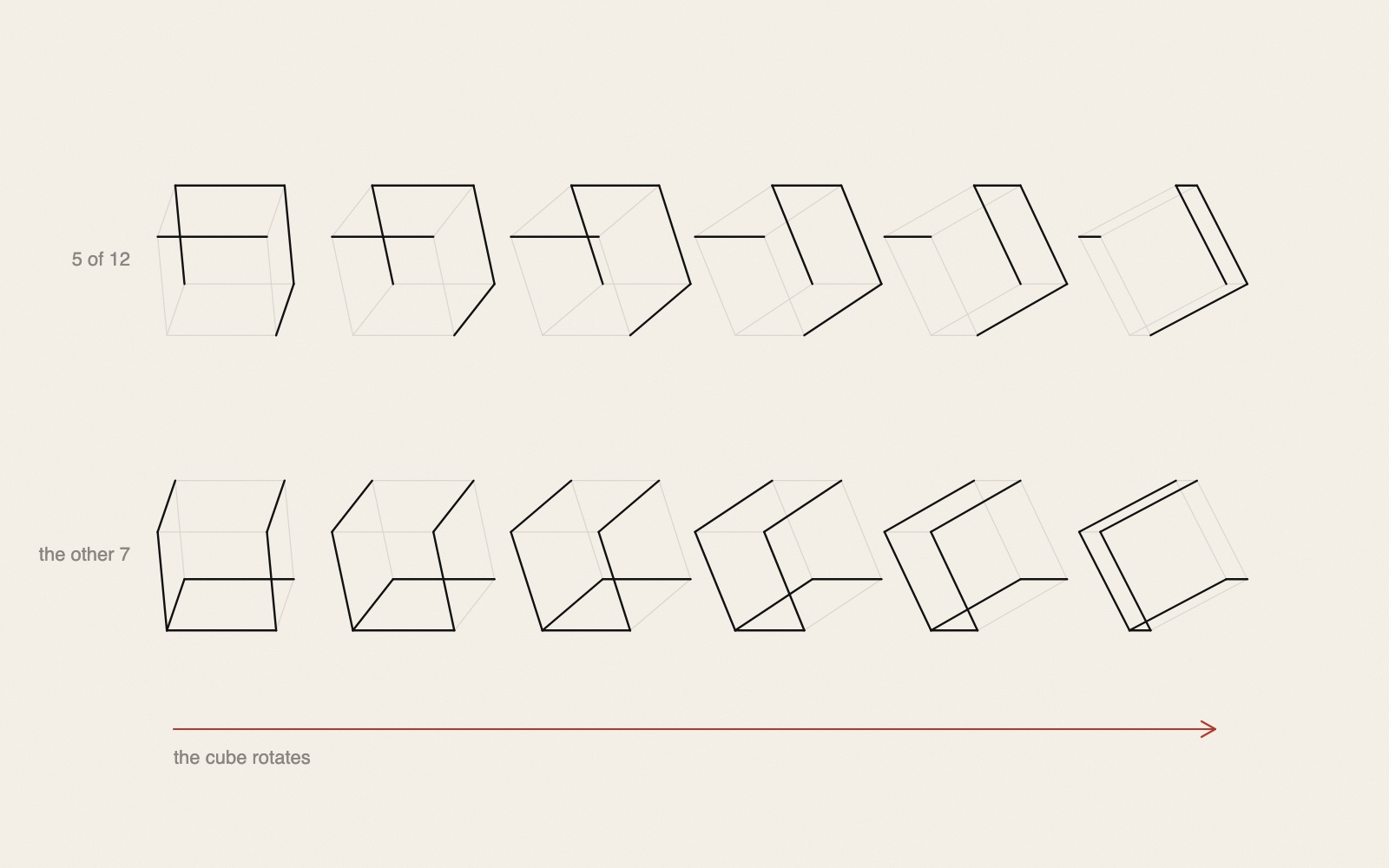
Cubic Limit is a series of drawings, etchings and films that Manfred Mohr made in Paris from 1973 to 1975. It is the first work in which he used one fixed structure, a cube, and treated its twelve edges as an alphabet: "The 12 edges of the cube became my alphabet to which I apply algorithms."1, 2 Almost everything below comes from Mohr's own pages on the series.
The alphabet
A cube has eight corners and twelve edges. Mohr's programs choose a subset of the twelve lines and draw only that subset, and the familiar object becomes a sign that is hard to read as a cube. He had worked the same way with the lines of squares and triangles the year before, in 1972; Cubic Limit moved the idea to three dimensions and added rotation: as the cube turns, the chosen lines are projected onto the paper at each new angle.1
Mohr lists the operations he used in the series:1
- series of all combinations of a given number of lines, n at a time;
- operations from symbolic logic applied to sets of lines;
- clusterings of elements;
- complementary elements: a set of lines next to the lines it leaves out;
- diagrams that explain the process, with numbers alongside the lines.
All combinations
In 1975 Mohr showed "all combinations of n-lines of cube at time in series of 13 drawings".2 The work is P-161.3 The arithmetic is simple. From twelve edges one can choose none, one, two and so on up to all twelve: thirteen possible values of n. The number of different subsets grows quickly towards the middle: 12 ways to pick one line, 66 to pick two, 924 to pick six, and 4,096 subsets in all. A work from 1974 called Pascal Triangle arranges cube lines from 1 to 12 in circles that are summed into the circle above, the scheme by which those counts are built.3
The SIGGRAPH archive lists P-161 Cubic Limit as a plotter drawing of 38.5 × 153 inches and dates it 1973; Mohr's own list dates it 1975.4, 3
Live sketch
Drawings, etchings, films
In these years Mohr drew at night on the Benson plotter of the French weather service in Paris, which he used from 1970 to 1983.2 For the etchings of 1975 he "replaced the pen on the plotter with a steel needle and drew on a treated copper plate"; the first hundred copies of the catalogue each contained one.2, 1
The 16 mm film Cubic Limit (1973–74, around four minutes) was made on a Datagraphix 4460 belonging to the firm C.G.M.: "each frame, generated by the algorithm, was drawn with a light beam on a small high resolution screen" and photographed onto film. Complementary Cubes (around five and a half minutes) shows two rotating cubes, one with n edges and the other with the remaining 12 minus n.5
Where it was shown
The series opened at Galerie Weiller in Paris on 29 May 1975, and the show was extended to 15 July. Michel Conil Lacoste reviewed it in Le Monde on 3 July. It then travelled to five more galleries in 1975–76.1, 2, 3 What came after, the cut cubes of Cubic Limit II and the hypercube, is told in JAEV's editorial on Mohr, which also compares his cubes with Sol LeWitt's of 1974. Olof Broström's Automatic Colour Cubes at JAEV uses a cube in another way: each of its 122 works opens a colour cube along the edges that one of LeWitt's 122 Incomplete Open Cubes leaves out (see the RGB colour cube).6
Sources
- Manfred Mohr, “Cubic Limit, Generative Drawings, Part 1. Travaux de 1973–1975”, Galerie Weiller, Paris, 1975. emohr.com
First workphase with a fixed cube as structure, the cube's lines as alphabet; extends the 1972 drawings with lines of squares and triangles; cube rotation introduced; subsets of the cube's lines; series of all combinations of n lines at a time, symbolic logic, clusterings, complementary elements, diagrams, numbers; drawings, etchings, films. Galerie Weiller 29 May – 28 June 1975, extended to 15 July; then Amsterdam, Neuchâtel, Stuttgart, Montreal, Hamburg. - Manfred Mohr, “50 Year Celebration: Time Line”. emohr.com
“The 12 edges of the cube became my alphabet to which I apply algorithms.” “I showed all combinations of n-lines of cube at time in series of 13 drawings, 1975.” “I replaced the pen on the plotter with a steel needle and drew on a treated copper plate.” Michel Conil Lacoste in Le Monde on the Weiller show. - Manfred Mohr, “Cubic Limit I – 1973–1975 and parts of Cubic Limit II – 1976–1977”. emohr.com
“The 12 edges of the Cube are used as an Alphabet.” P-154 (1973) pairs of complementary drawings; P-155, P-156, P-159 (1974) concentrations and slow rotation; P-161 (1975) 13 drawings, all combinations of n lines; P-163 (1975) logical operations; Pascal Triangle (1974), 1 to 12 cube lines; Le Monde review 3 July 1975. - “P-161 Cubic Limit”. ACM SIGGRAPH History Archives
Creation year 1973; plotter; 38.5 × 153 in; SIGGRAPH 1986: A Retrospective. - Manfred Mohr, “Computer generated films”. emohr.com
Cubic Limit (1973–74), 16 mm, around 4 min; “each frame, generated by the algorithm, was drawn with a light beam on a small high resolution screen”; DATAGRAPHIX 4460 of C.G.M.; Complementary Cubes, around 5½ min: 2 rotating cubes, one with n edges and the other with 12 minus n. - “Automatic Colour Cubes”, Olof Broström. JAEV, Lund
122 works, one a day; “Each work takes one of LeWitt’s 122 variants and applies it to the colour cube. The cube is reduced to its outer shell and opened along the edges that the variant leaves out”.
- Published
- JAEV Notes, October 2026.
- Use
- Text CC BY 4.0. Free to use and quote with credit to JAEV and a link to this page. Images and quotations by others keep their own terms.
All texts as one file: archive.json - Cite
- JAEV Notes, “Cubic Limit (Manfred Mohr, 1973–75)”, jaev.gallery/notes/manfred-mohr-cubic-limit/, 2026.
- Corrections
- Additions and corrections are welcome: info@jaev.gallery
- Share
A link from your own site, course page or reading list helps others find it.- Follow
- New notes by RSS · Instagram · Bluesky
JAEV is a daemon taking shape: machines, weights, room, brain.