Roman Verostko and the Algorists (1995)
JAEV Notes · October 2026 · 3 min read
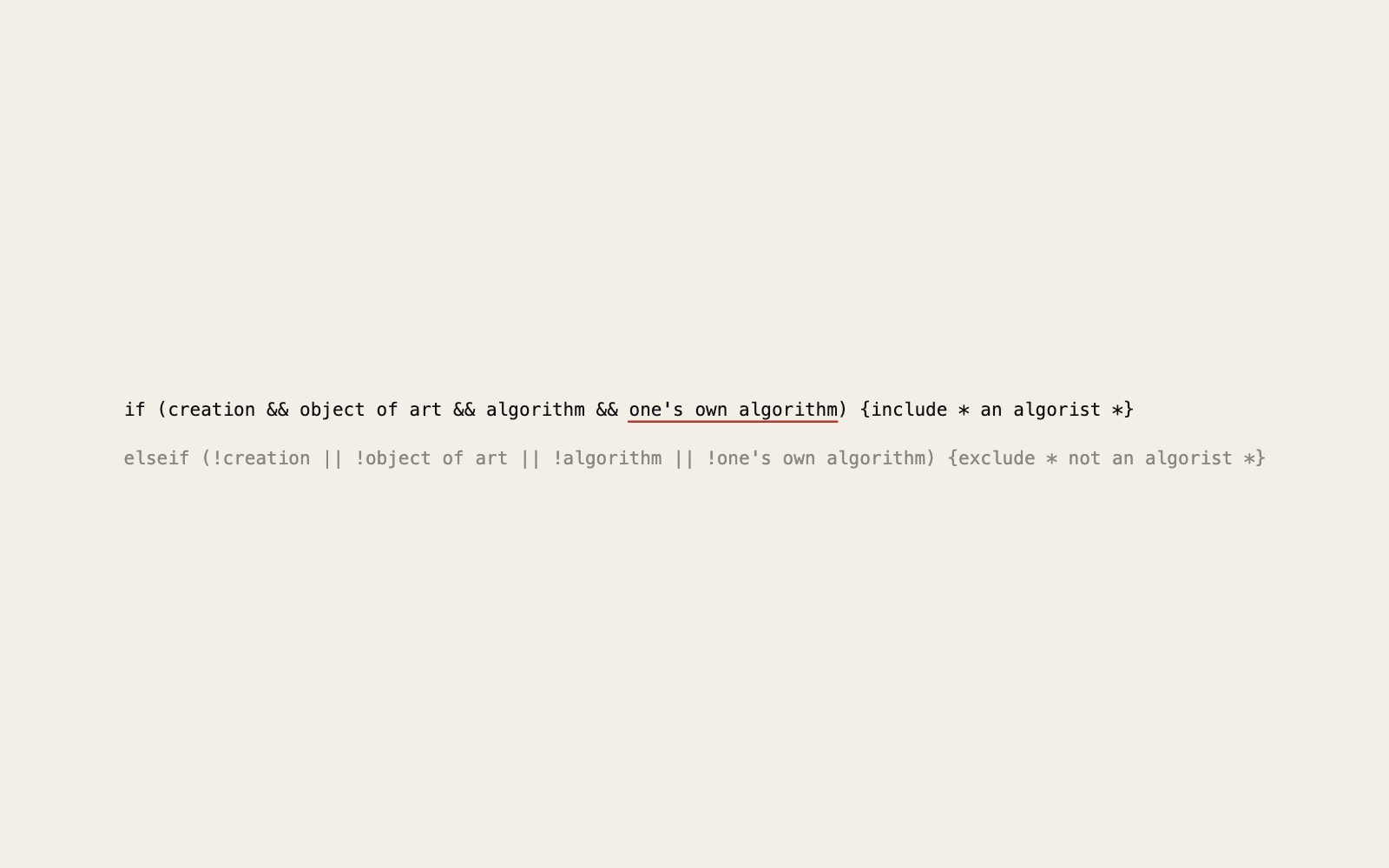
The algorists are artists who make art with algorithms they write themselves. The name was adopted in 1995 by a small group around the American painter Roman Verostko (1929–2024) and the artist Jean-Pierre Hébert (1939–2021), and Hébert wrote its definition as a piece of code.1, 2
How the name came about
At the SIGGRAPH conference in Los Angeles in 1995, the Belgian artist Peter Beyls chaired a panel called "Artists and Algorithms", with Hébert, Brian Evans, Stephen Bell, Ken Musgrave and Verostko. After the conference Hébert, Musgrave and Verostko wrote to each other looking for a name for what they did. In Verostko's account, "It was Jean Pierre who proposed using the term 'algorist'".1, 2
The word itself is old. An algorist was someone who calculates with algorisms, the step-by-step methods of arithmetic. Verostko points out that many of the group had been working this way for about 25 years before 1995, so the name gave an identity to a practice that already existed.1
The definition
Hébert noted that algorists "ought to be defined with an algorithm", and wrote one. Verostko quotes it "formatted precisely as received":1
if (creation && object of art && algorithm && one's own algorithm) {include * an algorist *} elseif (!creation || !object of art || !algorithm || !one's own algorithm) {exclude * not an algorist *}
Read as plain English: if something is a creation, an object of art, made with an algorithm, and the algorithm is the artist's own, the maker is an algorist; if any one of the four is missing, not. "It is the inclusion of one's own algorithms that makes the difference," Verostko writes. A computer is not required: he counts Channa Horwitz, who carried out her number-based rules entirely by hand, as an algorist.1 JAEV's The rule is the work draws the same line between writing a system yourself and prompting someone else's.
In 1996 Hébert put up web pages on the algorists that named an informal group, among them Harold Cohen, Charles Csuri, Hans Dehlinger, Helaman Ferguson, Manfred Mohr, Vera Molnár and Mark Wilson, "and others".1 Cohen's program is described in AARON's rules.
Verostko's brush on the plotter
Verostko was a Benedictine monk at Saint Vincent Archabbey in Pennsylvania from 1952 to 1968, and a painter. After leaving the order he taught at the Minneapolis College of Art and Design from 1968 to 1994.2, 3
He then wrote software that drew on paper, called Hodos, Greek for "path". It drove a 14-pen plotter, and in 1987 he added routines "to drive paint brushes mounted on a pen plotter drawing arm".3, 4, 2 In a paper from 1988 he calls the software a genotype, "the code for 'how to make the work'", which can make a family of works, each one unique. He found that Hodos produced paintings with "an uncanny resemblance" to what he had painted by hand before computers.4
How plotters are told where to go is explained in HP-GL; the wider history is in JAEV's Plotter Art and Generative Art.
Sources
- Roman Verostko, “The Algorists”. verostko.com
Panel “Artists and Algorithms”, SIGGRAPH 1995, Los Angeles, chaired by Peter Beyls, with Hébert, Brian Evans, Stephen Bell, Ken Musgrave and Verostko; “It was Jean Pierre who proposed using the term “algorist””; correspondence dated August 31, 1995; the definition “formatted precisely as received”; “It is the inclusion of one's own algorithms that makes the difference.”; 1996 pages by Hébert listing Abbe, Cohen, Csuri, Dehlinger, Ferguson, Mohr, Molnar, Wilson “and others”; Channa Horwitz worked entirely by hand. - “Roman Verostko”. Wikipedia (English)
12 September 1929, Tarrs, Pennsylvania – 1 June 2024, Minneapolis; Benedictine at Saint Vincent 1952–68; MCAD 1968–94; Magic Hand of Chance 1982, BASIC, first-generation IBM PC; Hodos; oriental brushes adapted to the drawing arm; co-founded the Algorists with Hébert in 1995. - Roman Verostko, résumé. verostko.com
“In 1987 he modified his software with interactive routines to drive paint brushes mounted on a pen plotter drawing arm.” 1952–68 Benedictine monk, St. Vincent Archabbey; 1994 Golden Plotter, First Prize, Gladbeck; 1993 Prix Ars Electronica, Honorary Mention. - Roman Verostko, “Epigenetic Painting: Software as Genotype” (FISEA, Utrecht, 1988). verostko.com
“The software, called Hodos, can generate paintings which bear an uncanny resemblance to work I did before becoming involved with computers.” “Hodos, the title for the software, means 'path' or road in Greek.” A personal computer driving a 14-pen plotter; Pathway series, 1988; software as genotype.
- Published
- JAEV Notes, October 2026.
- Use
- Text CC BY 4.0. Free to use and quote with credit to JAEV and a link to this page. Images and quotations by others keep their own terms.
All texts as one file: archive.json - Cite
- JAEV Notes, “Roman Verostko and the Algorists (1995)”, jaev.gallery/notes/algorists-verostko/, 2026.
- Corrections
- Additions and corrections are welcome: info@jaev.gallery
- Share
A link from your own site, course page or reading list helps others find it.- Follow
- New notes by RSS · Instagram · Bluesky
JAEV is a daemon taking shape: machines, weights, room, brain.